Landing a partnership with a household name like Burger King is often viewed as the ultimate win. On paper, it is the dream: high visibility, self-standing sites, and a captive audience with a predictable 20-minute dwell time.
However, a brand name is not a business case. If you are building your network based on brand prestige rather than granular stress-testing, you are not architecting a network, but betting on your gut feeling.
Need help evaluating a portfolio of sites and architecting your EV charging network?
Zoniq is always just a call away.
The Illusion of the Great Site
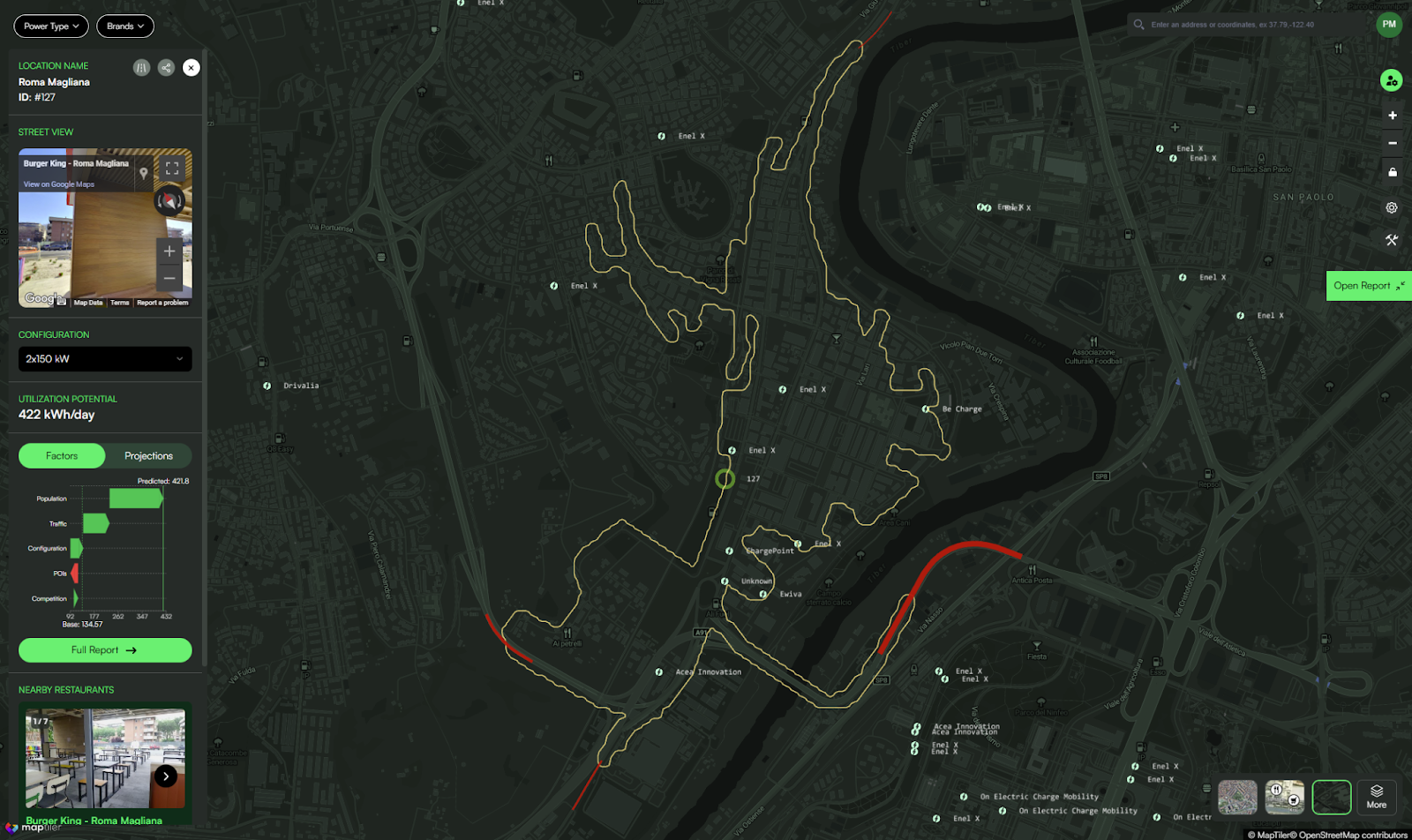
Most site selection today is based on little more than a map and a prayer. The assumption is that if the brand is big, the throughput will follow. Our analysis of the Burger King portfolio in Italy tells a different story.
Our assessment of the BK portfolio revealed a stark reality: 10 % of sites deliver 26 % of total potential. The remaining majority often falls into the market average. And in the world of infrastructure, average is a slow way to lose money.
The Zoniq Tiers: A Roadmap to Fiscal Reality
We do not look at "good" or "bad" sites; we look at systemic stability and time-to-profit. Using our proprietary models, we tiered the BK portfolio based on their ability to return capital:
- Tier A (The Strategic Hub): Locations suitable for hubs of at least 2 stations (4 HPC charge points). These are your priority assets, expected to become profitable before 2030.
- Tier B (The Scalable Node): Profitable before 2030 with a smaller 1 station (2 HPC) installation. These are resilient enough to scale into 4 HPC hubs by 2035.
- Tier C (The Tactical Placement): Profitable before 2035 with a small 1 station (2 HPC) configuration. These lack the demand density for larger configurations; over-building here creates a CAPEX trap.
- Tier D (The Red Zone): Just don't. These sites will not reach profitability within a standard infrastructure investment horizon.
How to Beat the Market
The market is noisy. In Italy, BEV registrations surged 82 % year-on-year in 2025, yet electric cars still only represent 5–6 % of new sales. Average utilization of charge points hovers around 6 %, way below the profitability threshold and is not expected to rise anytime soon.
To generate positive returns, you must identify the standout opportunities that drive a disproportionate share of throughput. Investors want more than market-average performance; they want resilient yields. Our analysis confirms that rightsizing configurations, matching the hardware to the specific node tier, can save 24 % of CAPEX with minimal loss to total network throughput.
In the BK portfolio in Italy, we found that regions like Lombardia and Lazio dominate, but even within these top-performing areas, site-level performance varies wildly. Investing in a Tier C site with a Tier A configuration is the fastest way to turn a green ambition into an expensive mistake.
Decisions over Dashboards
Investors do not need more data; they need conviction. They need to know that a "Go" decision is backed by operational reality, not local hype.
The lesson from the Burger King case study is clear: A great location partner provides the opportunity, but only data-driven rightsizing provides the ROI. If your site evaluation does not result in a clear tiering based on profitability timelines, you are simply guessing at scale.
Stop doing site selection. Start architecting networks.
–
The full evaluation with granular data and a detailed report are available in Zoniq Studio. Are you evaluating a tender and need help preparing the bid? Or you’re preparing a pipeline review for your next board meeting? Schedule a call with our consultants to help you build a high-conviction case.

